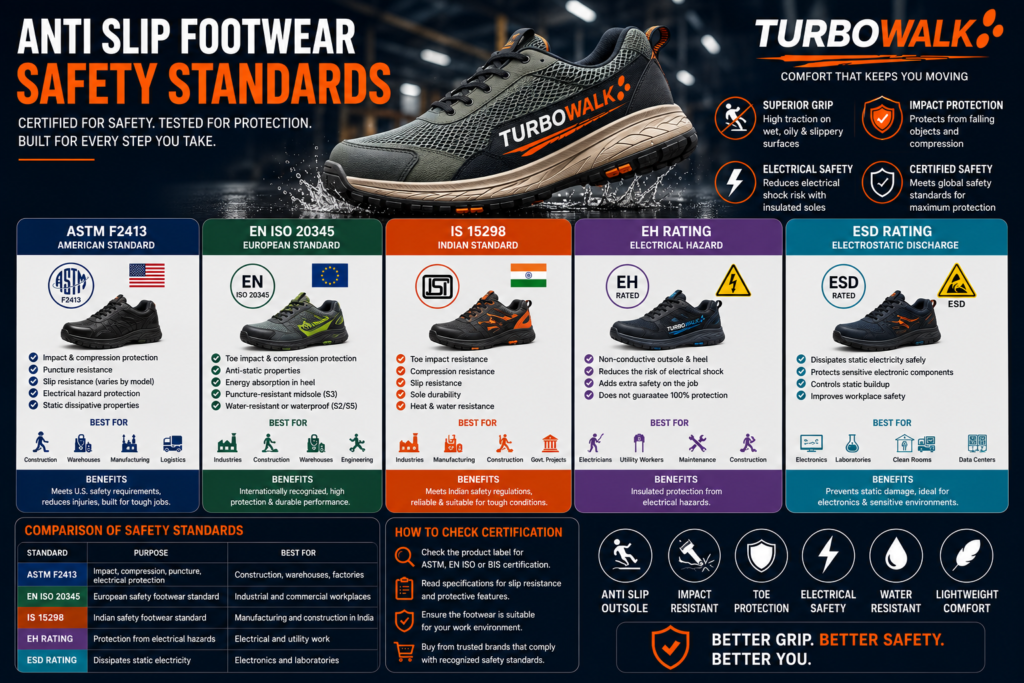
When purchasing anti slip footwear, comfort and style are important, but safety certifications are equally essential. These standards ensure that the footwear has been tested for slip resistance, impact protection, electrical safety, and overall durability. Whether you’re working in a hospital, restaurant, warehouse, or construction site, choosing certified anti slip footwear provides greater confidence and protection.
Below are the most recognized safety standards used worldwide.
ASTM F2413
ASTM F2413 is the American standard developed by the American Society for Testing and Materials (ASTM). It specifies the minimum performance requirements for protective footwear used in workplaces.
Footwear certified under ASTM F2413 is tested for:
- Impact resistance
- Compression resistance
- Slip resistance (depending on the manufacturer)
- Puncture resistance
- Electrical hazard protection
- Static dissipative properties
Best For
- Construction workers
- Warehouse employees
- Manufacturing industries
- Logistics professionals
Benefits
- Protects feet from heavy falling objects
- Reduces workplace injuries
- Meets U.S. workplace safety requirements
- Long-lasting and durable
EN ISO 20345
EN ISO 20345 is the European standard for safety footwear. Shoes meeting this certification must include a protective toe cap capable of withstanding significant impact and compression forces while also offering additional safety features based on their classification.
Common safety ratings include:
- SB – Basic safety
- S1 – Anti-static properties and energy absorption
- S2 – Water-resistant upper
- S3 – Puncture-resistant midsole with slip-resistant outsole
- S5 – Waterproof safety boots
Best For
- Industrial workplaces
- Engineering
- Warehouses
- Construction
- Food processing
Benefits
- High level of worker protection
- Internationally recognized certification
- Excellent durability
- Suitable for demanding environments
IS 15298
IS 15298 is the Indian Standard for protective footwear issued by the Bureau of Indian Standards (BIS). It is largely based on EN ISO 20345 and specifies safety requirements for footwear used in Indian industries.
The standard evaluates:
- Toe impact resistance
- Compression resistance
- Slip resistance
- Sole durability
- Heat resistance
- Water resistance
Best For
- Indian industries
- Manufacturing plants
- Construction companies
- Government projects
- Industrial safety programs
Benefits
- Meets Indian safety regulations
- Reliable workplace protection
- Suitable for harsh working conditions
EH (Electrical Hazard) Rating
Footwear with an Electrical Hazard (EH) rating is designed to reduce the risk of electric shock by providing insulation from the ground. These shoes use non-conductive materials in the outsole and heel.
Important: EH footwear does not guarantee complete protection against all electrical hazards. It should always be used alongside proper workplace safety practices.
Best For
- Electricians
- Utility workers
- Maintenance technicians
- Construction professionals
Benefits
- Reduces electrical shock risk
- Provides additional workplace safety
- Durable insulated outsole
ESD (Electrostatic Discharge) Rating
ESD-rated footwear is designed to safely dissipate static electricity from the body to the ground. Unlike EH footwear, which blocks electricity, ESD footwear controls static buildup to protect sensitive electronic equipment.
Best For
- Electronics manufacturing
- Laboratories
- Semiconductor industries
- Data centers
- Clean rooms
Benefits
- Prevents static electricity buildup
- Protects electronic components
- Improves workplace safety
Comparison of Anti Slip Footwear Safety Standards
| Standard | Purpose | Best For |
|---|---|---|
| ASTM F2413 | Impact, compression, puncture, electrical protection | Construction, warehouses, factories |
| EN ISO 20345 | European safety footwear standard | Industrial and commercial workplaces |
| IS 15298 | Indian safety footwear standard | Manufacturing and construction in India |
| EH Rating | Protection from electrical hazards | Electrical and utility work |
| ESD Rating | Dissipates static electricity | Electronics and laboratories |
How to Check if Anti Slip Footwear Is Certified
Before buying anti slip footwear, always:
- Check the product label for ASTM, EN ISO, or BIS certification.
- Read the manufacturer’s specifications for slip resistance and protective features.
- Verify whether the footwear is suitable for your work environment.
- Purchase from trusted brands that comply with recognized safety standards.
Conclusion
Choosing certified anti slip footwear ensures you’re wearing shoes that meet recognized safety and quality standards. Whether you need ASTM F2413, EN ISO 20345, IS 15298, EH, or ESD protection, selecting the right certification based on your work environment improves safety, reduces injury risks, and provides dependable performance.